
By Connor Gardiner September 29, 2026
Merchant account deposits to personal bank account setups can work for some true sole proprietors when the processor permits personal checking and can verify the proprietor, banking information, and authority over the account. But acceptance is provider-specific. A DBA or acquirer policy may make business checking necessary or cleaner, and the connected account may also support authorized processor debits.
The important distinction is not simply “personal account versus business account.” Merchant underwriting looks at who the merchant legally is, who controls the settlement account, which taxpayer information is being used, whether a DBA is involved, whether the account can be validated, and what the processor or acquiring bank allows.
A sole proprietorship also needs to be separated from an LLC or corporation. The IRS defines a sole proprietor as someone who owns an unincorporated business by themselves. That legal structure is one reason a bank account held by the proprietor personally may sometimes be acceptable—but it does not force every processor to accept personal checking.
| Situation | Can a Personal Account Work? | What Underwriting Checks | Cleaner Setup |
| Sole proprietor operating under legal personal name | Sometimes, if provider policy permits | Identity, TIN, account validity, ownership/control, banking details | Personal account may work; dedicated account is operationally cleaner |
| Sole proprietor using a DBA | Sometimes, but documentation matters more | Proprietor-to-DBA relationship, identity, bank details, applicable DBA records | Properly documented account connected to proprietor and DBA |
| Account owned only by another person | Frequently problematic | Ownership, authority, third-party settlement risk | Use an account the merchant can properly demonstrate ownership/control over |
| Joint personal checking | Provider-dependent | Applicant’s ownership or authority plus provider eligibility rules | Confirm before applying |
| Business checking tied to proprietor/DBA | Commonly easier to document | Same identity and business-verification checks still apply | Often the cleanest long-term setup |
| Merchant changing bank account after approval | Generally possible after verification | Authorized requester, new account, fraud controls, ownership/control where required | Verify the replacement before retiring the old account |
Can Merchant Account Deposits Go to a Personal Bank Account?
Yes, merchant account deposits to personal bank account arrangements can sometimes be approved for a genuine sole proprietor. There is no reliable basis for telling every sole proprietor that card-network rules universally require a business checking account.
What matters is the combination of legal structure and provider policy.
A traditional merchant account, acquiring bank, payment facilitator, or processor may require information sufficient to establish the merchant’s identity and business. The provider can also impose its own rules about what kind of bank account may receive settlements.
That creates several separate questions:
- Is the merchant actually a sole proprietorship?
- Who owns or controls the proposed bank account?
- Does the processor permit that type of checking account?
- Can the bank details be successfully validated?
- Is a DBA involved?
- Is the merchant’s TIN information consistent with its legal structure?
- Can the account receive settlement credits and support any legitimate debits required under the merchant agreement?
A personal account that truly belongs to the proprietor can therefore present a very different risk from an account belonging solely to an employee, friend, spouse, or unrelated company.
The distinction is important because the payment industry does not have one universal onboarding policy. One processor can accept a particular sole-proprietor arrangement while another legitimately declines it under its own underwriting standards.
“The Bank Account Name Must Exactly Match” Is Too Simplistic
The phrase merchant account bank account matching is often used as though every character on the bank-account title must be identical to the merchant application. That is not a safe industry-wide rule.
The more accurate principle is identity and relationship consistency.
An underwriter may need to understand the relationship among:
- the proprietor’s legal name;
- SSN or EIN being used;
- DBA or trade name;
- business address and contact information;
- bank routing number;
- account number;
- account holder;
- authority over the account; and
- merchant application.
The better underwriting test is whether the records establish a coherent relationship among the proprietor, business name, taxpayer information, and bank account.
FinCEN’s customer-identification guidance for sole proprietorships recognizes that banks may use fictitious- or assumed-name certificates where appropriate and may need information about the proprietor or another person with authority or control over the account when the business identity cannot otherwise be established.
That is very different from saying federal rules require every character in the bank-account title to exactly match every character on the merchant application. A processor or acquiring bank can impose a stricter naming standard, but that should be described as provider-specific underwriting policy rather than a universal card-network or federal requirement.
The IRS provides another useful illustration. Its 2026 information-return guidance says a sole proprietor’s individual name is used as the primary name and a DBA may be shown separately. It also recognizes that a sole proprietor who is not otherwise required to have an EIN may use an SSN in circumstances covered by that guidance.
A processor can still impose stricter requirements. The critical point is to label those correctly as processor/acquirer underwriting policy, not a universal Visa, Mastercard, IRS, or federal banking rule.
The Underwriting Question Is Really About Who Owns or Controls the Settlement Account

For merchant account deposits to personal bank account setups, underwriting usually becomes easier when the same individual clearly sits on both sides of the relationship: the individual owns the sole proprietorship and also owns or has acceptable authority over the bank account.
The processor wants a defensible explanation of where merchant funds are being sent.
That can involve verifying:
- the business owner;
- the legal structure;
- applicable TIN;
- the account number and routing number;
- whether the account exists and can accept transactions;
- the account holder or authorized party, depending on provider policy; and
- any DBA used in the merchant relationship.
Do not confuse account validation with account-ownership verification.
Do not confuse account validation with account-ownership verification. Under Nacha’s WEB Debit account-validation requirements, the minimum validation standard is aimed at determining whether an account is legitimate, open, and capable of receiving ACH entries; Nacha does not make ownership verification part of that minimum requirement.
A processor can still apply additional ownership, identity, or control checks as part of its underwriting and fraud controls.
Nacha expressly states that this minimum rule does not itself require verification of the account owner’s identity. A provider may conduct additional ownership or control checks as part of fraud prevention and underwriting.
This is why statements such as “Nacha requires your bank-account name to match your merchant account exactly” should not be used as a blanket explanation.
Example: Maria Lopez
Maria Lopez is a freelance photographer operating as an individual sole proprietor under Maria Lopez.
If her processor permits personal checking for sole proprietors, an account genuinely owned by Maria may be relatively straightforward to verify. Her legal identity, business ownership, and bank relationship all point back to the same individual.
Now suppose Maria markets the business as Lopez Event Photography.
Maria has not automatically created a separate legal entity merely by using that trade name. But the processor may want documentation establishing that Lopez Event Photography is Maria’s DBA, and the bank may have its own procedures for adding or recognizing the trade name.
That documentation issue is not unique to merchant processing. FinCEN’s bank-identification guidance specifically recognizes that sole proprietorships may be verified using applicable fictitious- or assumed-name records, while additional information about the individual proprietor or a person with authority or control may be needed when the business identity cannot otherwise be established.
When a Personal Checking Account Is Most Likely to Work
There is no approval formula, but a personal account generally creates fewer unanswered questions when the sole-proprietor structure is simple.
A merchant account deposits to personal bank account arrangement may be easier for a provider to approve when:
- the business really is an individual sole proprietorship;
- the same proprietor owns or properly controls the checking account;
- the processor permits consumer checking for that merchant type;
- the legal identity and TIN information are consistent;
- any DBA is properly documented where required;
- the routing and account information can be validated;
- the account can receive settlement credits;
- required processor debits can be supported; and
- there is no unexplained third party between the merchant and the bank account.
Those are favorable conditions, not approval guarantees.
Risk profile still matters. The processor may consider industry, average ticket, expected volume, card-present versus card-not-present activity, business history, transaction model, chargeback exposure, and other underwriting information.
Provider policy also controls.
One payment company may allow a sole proprietor to use personal checking. Another may require a business bank account for card processing even though no federal law universally forces all sole proprietors to do so.
When Underwriting May Say No
Underwriting may reject the banking setup even if the business itself is legitimate.
The provider requires business checking
This can simply be an acquiring-bank or processor policy.
It should not be described as federal law unless the specific claim is actually supported by law.
The account belongs to someone else
An account owned only by a friend, employee, unrelated relative, or different company creates a much harder question: why are this merchant’s card receivables being routed to that party?
A spouse-only account can create the same issue if the merchant cannot satisfy the provider’s ownership or authorization requirements.
The merchant is not actually a sole proprietor
A one-owner LLC is not automatically interchangeable with an individual sole proprietorship for every legal, banking, or underwriting purpose.
The IRS itself distinguishes an individual sole proprietor from a single-member LLC while recognizing special federal tax treatment for some single-member LLCs.
The DBA cannot be connected to the proprietor
Using “Peak Home Renovations” on the merchant application while providing personal records for “Alex Turner” is not necessarily wrong. But the processor may require evidence explaining the relationship.
Bank verification fails
A mistyped routing number, closed account, blocked ACH functionality, unsupported account type, or unsuccessful validation can stop funding setup.
Material information conflicts
Different addresses, taxpayer names, legal entities, ownership information, or banking records can cause additional review.
That does not mean every inconsistency automatically causes account termination or a funding freeze. The processor may instead request clarification or documentation.
How a DBA Changes the Bank-Account Question
A DBA—”doing business as,” trade name, assumed name, or fictitious business name—is a name under which the proprietor conducts business. A DBA does not by itself turn a sole proprietorship into a corporation or LLC.
That distinction is central to DBA bank account merchant services onboarding.
Consider:
Legal owner: Jordan Lee
DBA: North Shore Design Studio
Jordan remains the individual proprietor. North Shore Design Studio is the trade name used by the business.
Depending on the jurisdiction and bank, Jordan may need registration or other documentation before the bank will recognize the DBA. Banks do not all use the same documentary rules or account-titling conventions.
The settlement account might therefore be represented by the bank in a format connecting Jordan to the DBA, but merchants should not invent their own naming syntax based on what another bank uses.
Let the bank establish the official account title.
Then give the processor truthful information showing the relationship among Jordan Lee, North Shore Design Studio, the TIN being used, and the bank account.
The objective is a coherent documentation trail.
Why a Dedicated Business Bank Account Is Usually the Cleaner Setup
A business bank account for card processing is often the better operational choice even when personal checking technically passes underwriting.
The argument is practical rather than absolute: merchant processing creates a recurring stream of deposits, fees, refunds, adjustments, disputes, and accounting records. Separating that activity from household cash flow makes those events easier to control.
1. Settlement reconciliation becomes much easier
Card sales do not always translate into one bank deposit that exactly equals a day’s gross sales.
Multiple batches, refunds, settlement timing, fees, adjustments, and provider billing structures can change what appears in the bank.
A dedicated account allows the merchant to compare processor funding reports with banking activity without sorting through personal transactions.
When reconciling card deposits, compare each bank credit with the processor’s batch totals, refunds, adjustments, and fees rather than expecting gross card sales to equal the amount deposited. Learning how to read a merchant services statement and trace sales, fees, adjustments, and net deposits makes discrepancies much easier to isolate.
2. Form 1099-K reconciliation is cleaner
Payment-card reporting is a tax-information issue, not a bank-account-title rule.
The IRS says recipients should use Form 1099-K together with their records to determine the correct income to report. The form reports payment activity; it should not be treated as a simple statement of taxable profit.
Keeping card settlements in a dedicated account can make reconciling payment reports, accounting records, refunds, and processor statements easier.
3. Chargeback activity stays away from household cash flow
A card dispute can ultimately create a debit, settlement reduction, negative processing balance, or other recovery mechanism depending on the merchant agreement.
The exact mechanism is contractual.
For example, current Braintree/PayPal payment terms state that amounts arising from chargebacks, refunds, payment errors, or other liabilities may be deducted, set off, or recouped from payouts and that the merchant may be required to keep its bank account available for open settlements, chargebacks, and adjustments. That is a provider-specific contractual example—not a rule granting every processor identical rights.
4. Processing fees become easier to audit
Processors use different billing models.
Fees may be deducted before funding, billed separately, or collected through another contractual mechanism. The merchant agreement determines the arrangement.
When processing expenses are isolated, comparing the amounts deducted or debited with the fee schedule is much easier.
When processor fees are deducted from settlements or debited separately, compare each recurring charge with the pricing schedule and merchant agreement. Understanding how merchant-services fees are structured and disclosed also helps separate legitimate processing costs from unfamiliar charges that need further review.
5. Reserves and risk adjustments are easier to trace
Some merchant agreements permit the processor or acquirer to establish reserves, hold settlement amounts, offset amounts owed, or recover specified liabilities.
The exact authority and mechanism depend on the contract.
Do not assume every processor can arbitrarily withdraw any amount from the merchant’s checking account.
6. Bookkeeping becomes cleaner
Personal spending can quickly obscure merchant activity.
A single checking statement might otherwise contain:
- processor settlements;
- rent;
- groceries;
- personal subscriptions;
- merchant fees;
- refunds;
- household utilities;
- chargeback adjustments; and
- supplier payments.
A separate account turns reconciliation into a business-ledger exercise instead of a transaction-sorting project.
7. Banking information remains more stable
Changing a settlement account is a security-sensitive event.
A dedicated account that remains open and properly funded reduces avoidable changes to one of the core records associated with the merchant account.
Remember: Merchant Deposits Are Not Necessarily One-Way ACH Traffic

A central mistake with merchant account deposits to personal bank account setups is focusing only on what happens when money arrives.
The connected account may also be involved in contractually authorized debits or adjustments.
Depending on the provider and merchant agreement, these can include:
- chargebacks;
- refunds or reversals;
- processing fees;
- billing corrections;
- negative settlement balances; and
- other specifically authorized amounts owed under the agreement.
The processor’s rights come from the merchant agreement, related banking authorization, and applicable payment rules. Connecting an account does not create an unlimited right to remove arbitrary funds.
The practical problem with personal checking is therefore cash-flow collision.
Imagine that the same account is expected to cover:
- a mortgage payment on Monday;
- household utilities on Tuesday;
- groceries throughout the week; and
- automatic personal loan payments on Friday.
A legitimate chargeback or processor debit arriving in that account can reduce the balance available for unrelated household obligations.
That risk can exist even though the merchant’s personal account technically satisfies underwriting.
For that reason, merchants considering merchant account deposits to personal bank account setups should ask both:
Can card settlements be credited to this account?
and
What permitted debits or adjustments can also affect this account?
The second question is frequently more important operationally.
What Happens If You Change Bank Accounts After You Start Processing?
Changing the settlement bank account is usually possible, but it should be treated as an authenticated financial change.
Settlement-bank changes are attractive fraud targets because changing the destination can redirect future merchant funds.
A typical process may look like this:
- The merchant requests the bank-account change: Use the processor’s authenticated portal or another approved method.
- The processor authenticates the requester: This may include account credentials, multifactor authentication, security review, or another method.
- The new routing and account details are collected.
- The processor validates the banking information.
- Ownership or authority may be verified according to provider policy.
- Additional documentation may be requested.
- The provider establishes when the new banking instructions become effective.
- Future settlements are routed according to the approved change.
There is no universal bank-change processing time that should be quoted across the industry.
Verification methods vary
A processor may use one or more of the following:
- secure instant bank linking;
- account-validation databases;
- microdeposits;
- recent bank statement;
- voided check;
- bank letter;
- signed bank-change document; or
- manual underwriting review.
Instant verification has therefore not made every traditional verification method obsolete.
Nacha identifies prenotification, micro-entry verification, and commercially available validation services among possible account-validation approaches.
That also explains why a merchant may encounter different verification methods after changing settlement bank account merchant processor information.
Do This Before Closing the Old Account
- Submit the replacement account to the processor.
- Complete all requested verification.
- Confirm that the processor has accepted the banking change.
- Establish when settlements are expected to switch.
- Confirm an expected settlement reaches the new account.
- Review whether delayed fees, refunds, chargebacks, or adjustments could still affect the old relationship.
- Preserve the change confirmation and bank documentation.
Do not close the original account merely because the replacement bank account has been opened.
If the processor has not completed the change, a settlement sent using obsolete banking information may fail or require additional handling.
Personal Checking vs Dedicated Business Checking
| Issue | Personal Checking | Dedicated Business Checking |
| Underwriting acceptance | Provider-dependent | Often easier to document, but approval is not guaranteed |
| DBA handling | Can require extra explanation | Often cleaner when bank recognizes documented trade name |
| Settlement reconciliation | Mixed with household transactions | Processing activity remains isolated |
| Chargeback impact | Can affect personal cash flow | Kept within business cash flow |
| Processing-fee debits | Mixed with personal activity | Easier to identify |
| Accounting | More sorting and classification | Cleaner ledger |
| Bank usage policy | Must confirm business use is permitted | Intended for business activity |
| Merchant bank changes | Provider-dependent | Provider-dependent |
| Approval guarantee | No | No |
This is why the best argument for a separate account is not “the card networks force you to have one.”
The better argument is: a dedicated account creates cleaner underwriting evidence, settlement reconciliation, bookkeeping, and cash-flow control.
The 15-Minute Sole Prop Payment Processing Setup Order
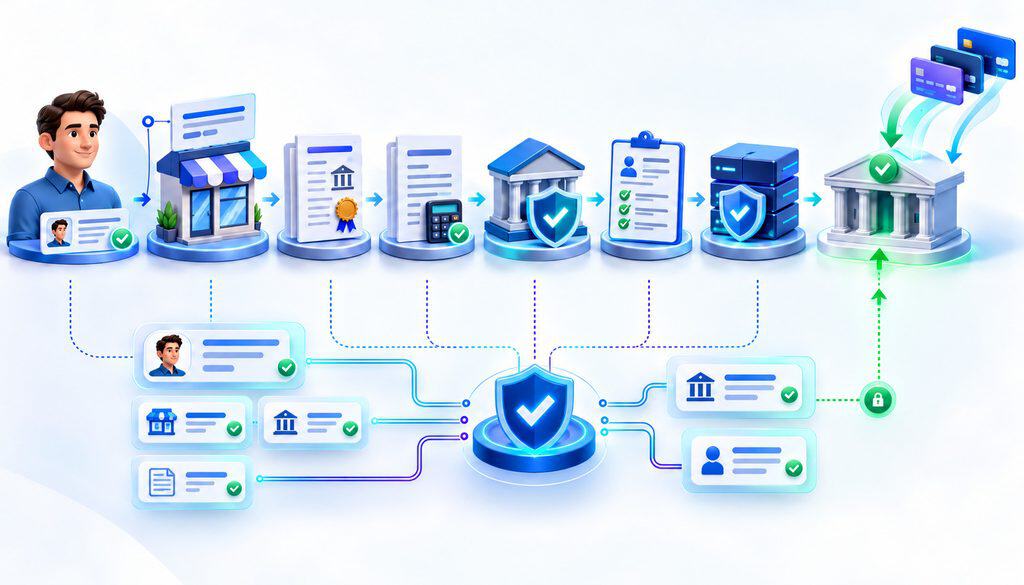
A clean sole prop payment processing setup starts before the merchant application.
Following the right sequence helps the records make sense when underwriting reviews them.
Step 1: Confirm the legal structure
Determine what legally operates the business.
Possible structures include:
- individual sole proprietorship;
- single-member LLC;
- multi-member LLC;
- partnership; or
- corporation.
A single-member LLC should not automatically be entered as a sole proprietorship merely because one person owns it.
Federal tax rules can treat certain single-member LLCs as disregarded entities for some income-tax purposes, but that does not erase the LLC’s existence under state law.
Step 2: Decide whether the business uses the proprietor’s name or a DBA
If you operate as Taylor Morgan Photography and your legal name is Taylor Morgan, determine whether the relevant jurisdiction requires an assumed-name or DBA filing.
Keep whatever documentation applies.
DBA requirements are not identical across every state, county, municipality, or bank.
Step 3: Determine what TIN applies
Do not assume every sole proprietor must obtain an EIN.
Current IRS guidance says businesses generally need an EIN for situations such as hiring employees, operating a partnership or corporation, paying certain taxes, changing certain structures or ownership, or administering specified trusts and plans.
The IRS also allows legitimate business applications for EINs in circumstances where a sole proprietor wants one for business purposes.
Its 2026 information-return instructions also state that sole proprietors who are not otherwise required to have an EIN may use their SSNs in the circumstances addressed by those instructions.
An EIN does not create an LLC, corporation, or liability shield.
Step 4: Establish the bank account
A clean operational order is usually:
legal structure → DBA decision → TIN decision → bank account → merchant application
This makes the documentation presented during underwriting easier to reconcile.
If you choose personal checking, first determine whether both the bank’s account terms and the processor permit the proposed use.
If you choose a sole proprietor DBA checking account, provide the bank whatever trade-name documentation it requires.
Step 5: Confirm required banking functionality
Make sure the proposed merchant account settlement account can receive the processor’s credits.
Also determine what debit functionality the processor requires under its agreement.
This is broader than asking, “Can somebody ACH money into my checking account?”
Step 6: Submit the merchant application consistently
The basic sole proprietor merchant account requirements vary by provider.
Use the truthful legal name, DBA, TIN, address, ownership information, and banking details that correspond with the records you have assembled.
Avoid creating a mismatch by calling the merchant an LLC on one document, an individual proprietor on another, and an unrelated corporation on a third.
Step 7: Verify the first settlement
Once processing begins:
- process the expected transactions;
- confirm the first expected funding reaches the correct account;
- match settlement reports to the bank activity;
- retain the merchant agreement;
- retain any ACH authorization or banking-change records; and
- separately verify how the customer-facing statement descriptor appears.
The bank-account title and cardholder statement descriptor are not the same thing.
The settlement account identifies where merchant funds are handled. The billing descriptor helps a cardholder recognize a transaction.
Documents a Sole Proprietor Should Have Ready
Exact requirements vary, but a proprietor can reduce avoidable delays by preparing the records commonly used during onboarding.
Depending on the provider, industry, and risk profile, the underwriter may request:
- government-issued identification;
- SSN or EIN information;
- DBA or assumed-name documentation;
- bank statement;
- voided check;
- bank letter;
- business address documentation;
- website or business information;
- business license, where applicable;
- processing statements from an existing operation;
- supplier or operational information in some higher-risk reviews; and
- owner or authorized-contact information.
Do not submit altered banking documents merely to make account titles appear to match.
If there is a legitimate difference—for example, the bank uses the proprietor’s legal name while the merchant trades under a DBA—document that relationship instead.
Once processing begins, retain monthly statements alongside bank records and onboarding documents. Being able to trace card sales, processor charges, adjustments, and net deposits on the merchant statement gives the business a stronger record when a funding amount or bank debit needs to be investigated.
FAQs
Can merchant account deposits go to my personal checking account?
Sometimes. Merchant account deposits to personal bank account checking can be accepted for some true sole proprietors when the processor allows that account type and can satisfactorily verify the merchant and banking relationship. Do not assume every processor accepts the same arrangement.
Do sole proprietors need a business bank account for card processing?
There is no universal rule in the primary sources reviewed requiring every U.S. sole proprietor to use business checking simply because the business accepts cards. A processor, acquiring bank, payment facilitator, or bank can nevertheless require a business account under its own policy.
Does the bank-account name have to exactly match the merchant-account name?
Not as a universal industry rule.
A provider needs sufficient consistency to understand who the merchant is, which legal or DBA names apply, what TIN is being used, who owns or controls the bank account, and whether the banking information is valid. Some providers may impose an exact or closer naming standard as their own underwriting policy.
Can I use a joint personal bank account?
Possibly.
Joint-account treatment depends on the processor’s policies and its ability to establish that the merchant has acceptable ownership or authority over the account. Confirm eligibility before relying on joint checking for settlement.
Can card sales be deposited into my spouse’s bank account?
An account owned solely by a spouse can create a third-party funding issue because the processor must understand why merchant receivables are being sent to someone other than the merchant.
Use an account whose ownership or authorized control can be properly demonstrated under the provider’s requirements. Do not assume marriage alone overrides underwriting policy.
What if I use a DBA?
Disclose the DBA accurately and maintain whatever assumed-name documentation applies to your jurisdiction and banking relationship. The DBA does not create a new legal person, but the processor should be able to connect the trade name to the individual proprietor.
Do I need an EIN to open a merchant account as a sole proprietor?
Not every sole proprietor is universally required by the IRS to obtain an EIN.
IRS rules require EINs in specified circumstances, while sole proprietors may also obtain EINs for legitimate business purposes. The merchant processor or bank may separately request particular taxpayer-identification information.
Is an SSN acceptable for a sole proprietor?
It can be in circumstances where the sole proprietor is not required to use an EIN and the provider’s onboarding rules permit it. IRS guidance expressly recognizes use of an SSN by certain sole proprietors who are not otherwise required to have an EIN.
Can I change the bank account after my merchant account is approved?
Usually, yes, subject to the provider’s change and verification procedures. Expect authentication, validation of the new bank information, and potentially supporting documents or manual review.
Will changing bank accounts delay deposits?
It can if the new settlement account has not been validated or approved when a settlement is ready. There is no universal industry-wide bank-change delay that applies to every provider, so do not close the original account based on an assumed number of days.
Can a processor debit my personal checking account for chargebacks?
Potentially, if the merchant agreement and applicable authorization allow recovery from the connected account. The processor’s rights are defined by the agreement and applicable rules. Connecting a bank account does not create unlimited withdrawal authority.
Can processing fees also come out of the settlement account?
Depending on the processor’s billing model, yes.
Some fees may be deducted from settlements, while others may be billed or debited separately under the agreement. Review the merchant agreement and actual statement rather than assuming one model applies everywhere.
Is a business checking account better even if personal checking is allowed?
For many sole proprietors, yes from an operational standpoint.
It separates merchant settlements, fees, refunds, chargebacks, adjustments, and business expenses from household cash flow. That can make payment reconciliation and accounting significantly easier without changing the legal nature of the sole proprietorship.
Does a DBA require a separate bank account?
A DBA by itself does not create a separate legal entity, so there is no universal answer that every DBA requires a separate bank account. Bank policies and local DBA requirements differ. The processor may also have its own expectations for documenting the proprietor’s connection to the trade name.
Does a merchant account bank-account mismatch automatically freeze funding?
No universal rule says every discrepancy automatically produces a funding hold.
A discrepancy can cause additional verification, manual underwriting, rejection of a bank change, or another provider-specific response. The actual result depends on the nature of the inconsistency and the processor’s policies.
Is a voided check still necessary?
Sometimes, but not universally.
Electronic validation, bank-linking services, microdeposits, statements, bank letters, voided checks, and manual verification all remain possible depending on the provider and circumstances.
Final Setup Recommendation
For a true sole proprietor, merchant account deposits to personal bank account arrangements can be legitimate when the processor permits them and can satisfactorily verify the proprietor, taxpayer information, banking details, and authority over the settlement account. A DBA adds another relationship to the document; it does not create a new legal entity.
The better operational setup is often a dedicated bank account because card-processing activity includes more than incoming deposits. Fees, chargebacks, refunds, adjustments, and contractually permitted debits can also affect the connected account.
Keep legal-name, DBA, TIN, banking, and merchant-application information consistent and explain legitimate differences rather than trying to manufacture an exact name match. If the bank account changes later, complete the processor’s verification and confirm the new funding path before closing the old account.